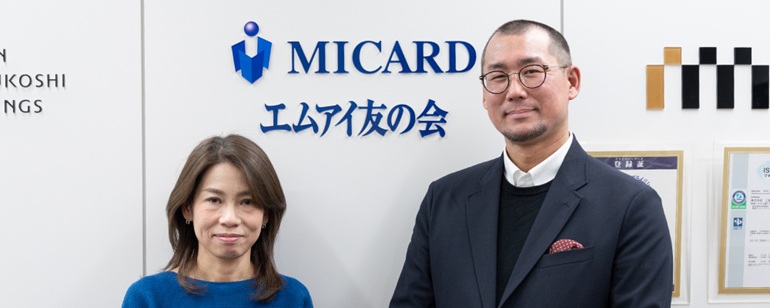
Systems Department, Systems Division, Assistant Manager
Mr. Mitsuru Yamagata
Sales Division, Insurance Sales Department—Insurance Sales Section 2
Ms. Kyoko Tsukamoto
Services Used
SMS Connect (Web Console / API) (Approval Feature) (Opt-out URL)
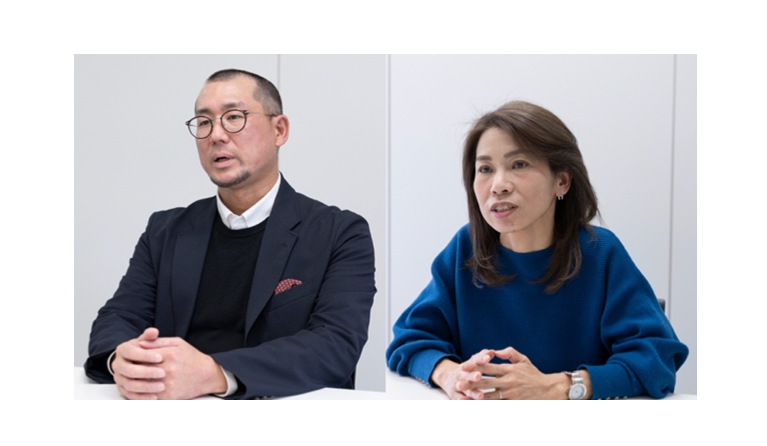
――Please tell us about MI Card’s business operations and the areas each of you is responsible for.
Mr. Mitsuru Yamagata (hereinafter “Yamagata”): As our company name suggests, we are a credit card issuer that issues cards for the Mitsukoshi Isetan Group. We also sell insurance and financial products to our card members.
I am a member of the Systems Department and am in charge of systems planning.
Ms. Kyoko Tsukamoto (hereinafter “Tsukamoto”): I am primarily responsible for the insurance business, and specifically handle new policies, as well as follow-up for policies nearing expiration or renewal, for current employees and former employees of the Mitsukoshi Isetan Group who hold auto, fire, and accident insurance policies. I handle these procedures remotely, generally speaking with customers over the phone as I process their requests.
――What kinds of challenges did you face when you first introduced SMS (Short Message Service)?
Yamagata: As for the Systems Department, we implemented this to enhance the security of the website for card members by requiring authentication using one-time passwords during login.
We were originally using another company’s SMS service, but as our number of web members grew, the number of authentication requests increased, and costs began to rise. While consulting with various companies to reduce costs, we came across Acreet.
Tsukamoto: One of the challenges we face in the Insurance Sales Department is that customers often don’t answer our calls. Whether it’s because we’re calling from a toll-free number, because they suspect it might be a scam, or because our business hours don’t align with their lifestyle, calls often go straight to voicemail. Since SMS leaves a record that serves as “proof of delivery,” we decided to implement it as another way to reach out to customers. We wanted to use it as a way to prompt customers to take action.
The Insurance Sales Department had previously been using another company’s SMS system, but we faced challenges in terms of both cost and functionality when it came to using it to reach out to new customers. Just as the life insurance team in the same department was struggling with the same issue, I heard that “the IT Department had apparently implemented a good SMS service” (laughs). Mr. Yamagata introduced us to the service, and we ended up signing up for SMS Connect.
――So, the fact that the Systems Department implemented SMS Connect first helped encourage the Insurance Sales Department to switch over as well, right?

――Looking at your company’s website, it seems there are still a fair number of non-web members. Are SMS messages proving useful?
Yamagata: We’ve been trying various approaches to increase our number of web members, and as a result, the number has been on the rise over the past year or so. Having a variety of approaches tends to yield better results, and I think SMS-based authentication is both very user-friendly and secure.
――I think communication with older adults is also important in insurance sales.
Tsukamoto: Many of our existing customers are in their 60s or older, and some are even over 80. While this generation tends to be wary of the internet, they do understand the broader trend toward paperless systems, so we provide them with detailed guidance via text messages. Sometimes they’ll call us asking, “I received something—what is this?”—and moments like that really make me realize that our text messages are driving action.
――Did the integration go smoothly when you implemented SMS Connect?
Yamagata: Since we had already been calling the service via API when using another company’s service, all we had to do was change the way we made the calls. I think the fact that they provided us with the specifications in advance was a major factor in enabling a smooth integration.
Tsukamoto: As for switching from another company’s system, while the field staff seemed a bit confused about how to use it at first, there was no major disruption. We’ve been able to operate it smoothly without any major incidents so far, which I’m glad about.
――How is the usability?
Tsukamoto: I use it myself, and I think it's good. So far, I haven't encountered any issues or found anything to be a concern.
――Has combining phone calls and text messages led to any changes in customer behavior?
Tsukamoto: I think so. There have been cases where we received a response immediately after sending a message, so based on our sales team’s experience, I definitely feel that it’s effective. We sometimes receive requests from customers such as, “I can’t take notes, so please send it via SMS,” or “Calling is a hassle, so please just send an SMS from the start,” and we’re aware of cases where applications were actually submitted via SMS.
Although our company has a policy that allows us to send only pre-approved standard messages, if we have a response that fits the situation, we can provide immediate assistance via SMS. We feel that phone numbers are easier to verify than email addresses, which reduces the risk of misdirected messages. Additionally, it eliminates the hassle for customers of having to register an email address or send a blank email, so we believe it’s a channel that works well for both parties.
――What about using SMS for authentication purposes? Is there a difference compared to other tools?
Yamagata: In addition to SMS, we also send one-time passwords via email. Whether you use SMS or email is really up to you. However, from an objective standpoint, I believe SMS has the edge in terms of security and reliability of delivery. You can feel confident receiving SMS messages sent from MI Card’s phone number.
With email, there’s inevitably a slight delay in delivery depending on the customer’s ISP or other factors, so in rare cases, the email may not arrive in time to meet the time limit for one-time password authentication. One advantage of SMS is that this rarely happens.
We haven't received any feedback saying it's "difficult to use" since the implementation, and I've heard from the call center department that operations are running smoothly without any particular issues.
――Did you notice any changes in your sales activities—such as call connection rates—before and after implementing SMS?
Tsukamoto: With phone calls, whether the call connects or not, we have to manually make each call one by one and enter the call history into our internal system. Each call takes at least 2 to 3 minutes—even at the fastest—and if the call connects, it takes even longer; if it doesn’t, we have to make arrangements to call back.With SMS, as long as we can extract the target phone numbers, all we have to do is select a pre-registered template, enter the approver’s name, and press the send button. Since we can immediately identify customers to whom the message cannot be delivered, we really feel the difference in operational efficiency on the ground.
After sending the SMS, we checked the actual response rate, which was about 10%. When we tallied the responses that resulted in some kind of action within one week, the rate was approximately 8.8%; if we include responses from more than one week later, the rate rises to 14–15%. However, the response rate within one week is the most reliable indicator of the SMS’s effectiveness.“Response” here includes not only return calls but also actions such as completing procedures online. Since we were unable to extract figures for phone calls alone, a direct comparison isn’t possible; however, from the perspective of improving operational efficiency, I feel this is a sufficient response rate.
――You’ve been using SMS Connect for over a year—please tell us about the changes you’ve seen since implementing it.
Yamagata: Switching to SMS Connect has helped us reduce costs. Since there are no particular performance limitations that cause concern, we’re actively using it in a variety of situations. I believe its range of applications within our member web services is expanding—for example, for additional authentication when making changes to important information after logging in.
――Are there any precautions you take or strategies you use when sending SMS messages?
Yamagata: From a system perspective, the key is to keep things “concise and easy to understand.” Since there’s a character limit—and data charges vary depending on the number of characters—we strive to make the messages as short and clear as possible. We also make sure to clearly state on our website that the messages are being sent from an MI Card number. These are the two main points we focus on.
Before we implemented SMS Connect, we used to send a different short code only to SoftBank-affiliated carriers, but now that we can send messages from the same sender number regardless of the carrier, I think it’s become much clearer for everyone—no one has to wonder, “Which company is this from?” anymore.
――Thank you. One of SMS Connect’s strengths is its ability to send messages to all carriers while displaying a landline number. ――How about the Insurance Sales Department?
Tsukamoto: In the Insurance Sales Department, we sometimes send out several hundred messages at once, so we register a large number of boilerplate messages. There’s a significant risk that if I accidentally click the wrong one, a completely different message will be sent, so I get nervous when making a selection. We thoroughly double-check everything to ensure we don’t send the wrong message—this is part of our internal training—but it still requires a great deal of care.
For these reasons, we’ve decided not to send free-form text messages. We strive to minimize risk as much as possible by sending only messages that have been approved internally—that is, messages that have been officially cleared for use and are free of errors, typos, or inappropriate phrasing. This is an area where we take great care within the company to ensure that even employees with little experience can handle it simply by following the manual.
――I understand that the approval feature was important when using the SMS service.
Tsukamoto: The SMS service we used previously didn’t have an approval feature, so we had to handle that manually in-house. Having an approval feature helps prevent accidental messages from being sent, and I especially like that it keeps a record of everything.
――Besides the approval feature, are there any other benefits you’ve found from choosing SMS Connect?
Tsukamoto: When considering the use of SMS for new business development, the biggest hurdle is the law. When sending emails or other messages to new customers, we have to comply with laws such as the Act on the Regulation of Specified Electronic Mail. For example, we need to obtain consent in advance and keep records of that consent.
In that regard, SMS Connect includes an “opt-out URL,” making it easy to unsubscribe. Customers who wish to opt out simply need to click the link, and we’ll stop sending messages to them.Even if an unsubscribed recipient is included in future SMS campaigns, they’ll be automatically excluded, right? Without this feature, we simply couldn’t use SMS for new business development, so it’s an indispensable part of our new business strategy—something our previous vendor didn’t offer. Since we’ve covered the key points needed to expand our sales activities going forward, I think the rest is up to our own initiatives. It’s a service packed with features we’re very grateful for.
――What do you think of Acrit's support system?
Tsukamoto: Since the manuals are available within SMS Connect, there are times when I can find a solution by searching. If that doesn’t work, I contact the support center by email or phone, and their quick response has been a huge help.
*The "Approval Feature," "Fixed Number Display for All Carriers," and "Opt-Out URL" are optional features of SMS Connect .
https://www.accrete-inc.com/service/onewaysms/
(Reference) What Is the Act on Specified Electronic Mail? An Explanation of Whether SMS and LINE Are Covered
https://www.accrete-inc.com/useful_information/20220622/
――Please tell us, to the extent possible, about your outlook for initiatives utilizing SMS going forward.
Tsukamoto: Within the Insurance Sales Department, the Life Insurance Division adopts what’s known as a “mail-order” sales model, in which we partner with a telemarketing company—their operators make the calls and handle everything from sending out materials to closing the deal.Since this department relies solely on the telephone, there are actually some advantages to using the phone when dealing with older adults. However, I’ve heard that even among older adults, many now use cell phones, and there are quite a few cases where we can’t reach them. It seems they’re currently working on a system to reach out to those customers via text message to finalize whether they’ll sign a contract or not.
While we won’t see immediate results, we believe this will serve as a new way to reach customers who are difficult to contact. Even in new business development, we plan to expand the scope of our efforts—while monitoring cost-effectiveness—by combining targeted SMS campaigns with our existing methods, such as email newsletters, direct mail, and telemarketing.
Yamagata: We use a variety of systems; for example, we’ve already been utilizing SMS for certain operations outside of our website—such as routing inquiry calls through an IVR (Interactive Voice Response) system or contacting customers with overdue payments. Going forward, it would be great if we could expand the range of systems that support SMS and explore ways to help customers become aware of the information they need.
In reality, the extent to which we implement these measures depends on a balance between effectiveness and cost, but there are some projects that the department in charge is moving forward with as system improvements, and I feel that the range of applications has expanded significantly since we introduced SMS Connect.
With the service we used previously, the cost per call was quite high, so I think the barrier to adoption has been lowered.
*"IVR" stands for Interactive Voice Response. When integrated with SMS, it allows you to send supplementary information via SMS in cases where the automated voice response alone is insufficient, ensuring that detailed information is delivered smoothly to users.
(Reference) What Is IVR? An Explanation of Its Uses and Benefits in Call Centers
https://www.accrete-inc.com/useful_information/20220523/
For this article, we spoke with MI Card. We hope this information will be helpful to those working in the IT and insurance sales departments. Although we were unable to include everything in this article, we received questions and feedback regarding the actual use of the service. We will continue to strive to make SMS Connect even more convenient.
Established in 1988 (Showa 63) as the credit card company of the Mitsukoshi Isetan Group. In addition to its credit card business, the company offers insurance and financial products, and places great importance on creating services that support customers’ daily lives based on a “customer-first” philosophy.