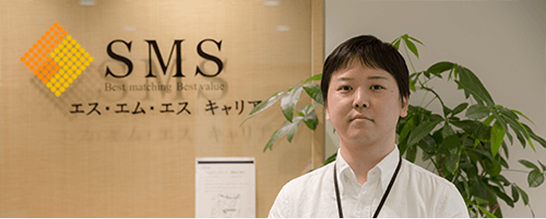
Media Planning Department, CRM Group
Mr. Tsutomu Oishi
Services Used
SMS Connect (Web Console / API)
――Please tell us about the business operations of the SMS Group and SMS Career.
The S.M.S. Group’s mission is to “continue creating value and contributing to society by building information infrastructure suited to an aging society,” and the Group’s overall business involves building information infrastructure in the fields of nursing care, medical care, careers, healthcare, and senior living.
Within this framework, S.M.S. Career, under the slogan “Empowering those who work in healthcare and nursing care—and empowering Japan,” aims to contribute to the continued provision of high-quality healthcare and nursing care services in Japan by building information infrastructure designed to address the shortage of workers in these fields.
――Is there a lack of information infrastructure in fields such as healthcare and long-term care?
I feel that information sharing in the medical and nursing care fields is still insufficient. For example, when hiring nurses, I often find that the job postings on hospital websites tend to be limited to a description of the employment terms.I’ve heard that because nurses aren’t able to learn about the facility’s amenities or hear from current staff—information they’d want to know before actually starting work—before they change jobs, this sometimes leads to early resignations even after the hospital has gone to the trouble of hiring them. That’s such a waste, isn’t it? While this is just one example, we believe it is our mission to solve the shortage of workers in the healthcare and long-term care sectors by providing an information infrastructure—a system that ensures job seekers receive the information they need.
――S.M.S. Career provides recruitment services across a wide range of medical and nursing care fields.
I’m in charge of CRM for “Nurse Talent Bank,” a recruitment service within our nursing division. I provide information to our registered job seekers via phone, email, text messages (SMS), and other channels.
For a service like ours, the first priority is to get as many people as possible to register. I may be biased, but I believe we’re the industry leader in terms of the number of registered nurses. However, since our registrants’ ultimate goal is to find a new job, communication is just as important as registration itself.Our registrants range from those who say, “I quit my job yesterday, so I want to find a new one right away,” to those who say, “I’m just looking around for now.” Since the frequency and intensity of communication that each registrant desires varies, I place great importance on TPO.
To put it another way, TPO means “being able to communicate at the right time, through the right means, with the right content.” I consider this to be both the foundation and a crucial aspect of our work.
――Could you tell us what led you to implement short message service (SMS)?
While there are various ways to communicate with our registered candidates—such as in-person meetings, phone calls, and email—until they ultimately change jobs, we are always looking to add even one more method that will yield consistent results. One of the methods we were considering was short message service (SMS).
――How do you feel text messages (SMS) differ from other forms of communication?
I think the biggest difference is that there’s a higher likelihood of the recipient noticing your message. Since job seekers often register with multiple services, they likely receive a large number of phone calls and emails—not just from us, but from other companies as well.However, when it comes to whether these methods are appropriate for the registrant’s specific time, place, and occasion (TPO), it’s honestly a bit of a dilemma. In such situations, while text messages (SMS) are just as likely to catch the recipient’s attention as phone calls, they have the advantage of allowing the registrant to read them at a convenient time, thereby ensuring they’re appropriate for the TPO. Looking at the click-through rates for URLs sent via text message (SMS), I feel they’re actually being read more than emails.
It’s a different situation, but even though I rarely get a reply when I email my boss, I get a response right away when I send a text message (SMS) (laughs). I think the fact that a “①” appears on the cell phone screen makes it easier for the recipient to notice the message.
However, I also feel that simply getting people’s attention isn’t enough—it’s important to provide multiple ways for them to read the message and take action easily. For example, by offering options such as phone calls or online access, I want to provide multiple methods that allow our subscribers to take action without feeling stressed.
――How do you choose between or combine text messages (SMS) and other communication methods (face-to-face, phone, email)?
If you think about which has a lower psychological barrier—answering a phone call or clicking a URL in a text message (SMS)—clicking the URL is probably the lower one. For example, I feel that text messages (SMS) are well-suited for confirming whether someone is interested in a job opening or is considering a career change.
On the other hand, face-to-face meetings or phone calls are effective for delving into deeper aspects, such as what kind of work style a person prefers or whether they intend to apply for a job. There are certain things you can only gauge by speaking directly with someone, like their demeanor or the tone of their voice.
Additionally, when sending regular updates to people who aren’t currently looking to change jobs, I use email. As I mentioned earlier, while emails are being read less frequently these days, unlike text messages (SMS), they have no character limit and are less likely to be perceived as a burden even when sent regularly. I choose between email, text messages (SMS), and phone calls (in-person) depending on the subscriber’s situation.
――How has your business changed since you implemented Acrit SMS?
At Nurse Talent Bank, while registering a cell phone number is required when signing up, registering an email address is not mandatory. Regardless of whether an email address is registered, the ability to send bulk notifications via text message (SMS) is extremely effective. For example, if you compare calling 10,000 people individually to sending a text message (SMS) to all 10,000 at once, text messaging (SMS) is clearly the more efficient option. It offers significant benefits in terms of both operator time and cost.
Another useful feature is that, even when it’s too late at night to make a phone call, you can now send a text message (SMS) if you need to get in touch urgently—which is actually quite convenient.
――Were there any concerns you had before sending a text message (SMS)?
Since it’s impossible to predict exactly how people would react in advance, I didn’t have any particular concerns, but I did take into account the possibility that a certain number of people might react negatively. Having actually tried it, I feel it was accepted better than I expected. Of course, we took steps within the PDCA cycle to prevent complaints, but I don’t think sending information via text message (SMS) to people who are already registered on a job search site is the kind of thing that would leave them feeling uncomfortable.
――Please tell us why you chose our company when implementing a short message (SMS) delivery service.
At our company, whenever we implement a new initiative, we follow a thorough PDCA cycle. We implement an initiative, identify any issues, and then implement an improved version. Even now, we continue to apply the PDCA cycle to our use of short messages (SMS).
Actually, initially, we were using a service other than Acreet for our short message (SMS) delivery.However, as we continued the PDCA cycle, we wanted to convey our specific requests, but that proved difficult with the other company. Acreet, on the other hand, stood out because we could hold regular meetings and exchange ideas. Furthermore, Acreet has incorporated our feedback to improve the service, and compared to when we first implemented it, it’s now much easier to use. We’re truly grateful that we’ve been able to work together on this.
――We are very grateful to receive your feedback from the perspective of actual business use. We have also received praise from other customers who say the admin interface has become much easier to use.
――Finally, could you tell us about your future aspirations?
I find it rewarding to be able to help build the industry’s No. 1 service from various perspectives. Going forward, I hope to gain experience by helping create services that are head and shoulders above the rest—not only in nursing but in other fields as well. At the same time, I’d like to use that experience to explore how I can contribute to meeting society’s needs.
――It really comes across that you find your work very fulfilling. Thank you very much.